
The tree service industry represents one of the most fascinating case studies in economic evolution, blending traditional craftsmanship with modern business practices. Having worked in this field for decades, I’ve witnessed firsthand how economic forces have shaped the way tree care companies operate, from the early days of individual arborists to today’s sophisticated service providers. Understanding this evolution provides valuable insights into how local markets develop and sustain themselves over time.
The Origins of Commercial Tree Care
Tree care as a commercial enterprise emerged during the late 19th century when urbanization created unprecedented demand for professional arborists. Before this period, property owners handled tree maintenance themselves or relied on general laborers with minimal specialized knowledge. The transformation began when cities recognized that street trees required expert care to thrive in urban environments.
Early tree service businesses operated on what economists call a “craft guild” model. Individual practitioners built reputations through apprenticeships and word-of-mouth referrals. These pioneers charged premium rates because their specialized knowledge was scarce and valuable. The economic barrier to entry was relatively low—a skilled climber needed only basic equipment like ropes, saws, and ladders to start a business.
The business model during this era was straightforward: charge by the job, work alone or with a small crew, and build a client base through personal relationships. This approach worked well in smaller communities where reputation served as the primary marketing tool and quality control mechanism.
The Mid-Century Transformation
The period from 1940 to 1980 brought significant changes to tree service economics. Several factors converged to reshape the industry fundamentally:
Technological Innovation
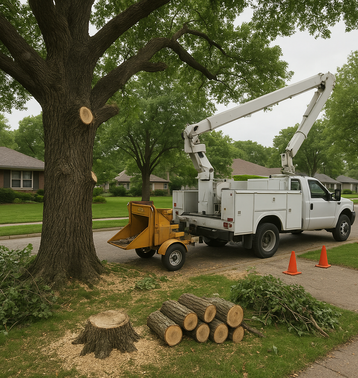
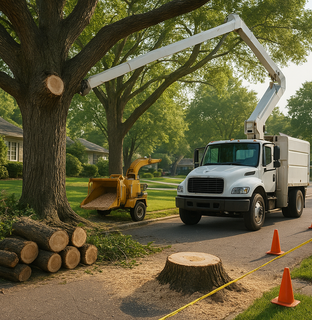
The introduction of chainsaws, bucket trucks, and wood chippers revolutionized productivity. Companies that invested in this equipment could complete jobs faster and safer, but the capital requirements created new economic dynamics. Suddenly, starting a competitive tree service required substantial upfront investment, raising barriers to entry and favoring established businesses.
Insurance and Liability
As legal frameworks evolved, liability insurance became essential. This shift transformed the economic landscape because insurance costs created fixed overhead that small operators struggled to absorb. Companies needed consistent revenue streams to justify these expenses, leading to more sophisticated business planning and customer acquisition strategies.
Specialization and Diversification
Some companies chose to specialize in specific services like hazardous tree removal or utility line clearance, while others diversified into related fields such as landscaping or stump grinding. These strategic choices reflected different economic theories about competitive advantage and market positioning.
Modern Business Models in Regional Markets
Today’s tree service industry exhibits remarkable diversity in business models, each responding to specific economic conditions and market demands. In regions like Arkansas, where seasonal weather patterns and diverse tree species create unique challenges, companies have developed particularly innovative approaches.
Professional Tree Service in Jonesboro, Arkansas: A Case Study in Market Adaptation
The evolution of tree care businesses in mid-sized communities throughout Arkansas demonstrates how local market conditions shape service delivery models. Jonesboro and similar cities present unique economic environments where tree service providers must balance residential, commercial, and municipal clients while adapting to regional weather patterns that include ice storms, high winds, and tornado activity. These geographical and demographic factors create demand patterns distinct from larger metropolitan areas or rural regions, requiring businesses to develop flexible operational capabilities.
The most successful operations balance multiple revenue streams while maintaining core competencies. Jonesboro Tree Service exemplifies this evolution, demonstrating how modern tree care businesses integrate traditional expertise with contemporary business practices to serve their communities effectively.
The Volume Model
Some companies pursue a high-volume strategy, focusing on rapid job completion and competitive pricing. This model requires:
- Significant equipment investment to maximize efficiency
- Large crews capable of handling multiple jobs simultaneously
- Aggressive marketing to maintain consistent workflow
- Streamlined operations to keep per-job costs low
This approach works best in densely populated areas with steady demand. The economic logic relies on economies of scale—spreading fixed costs across many jobs to achieve profitability despite lower margins per project.
The Premium Service Model
Alternatively, some businesses position themselves as premium providers, emphasizing quality, expertise, and customer service over price competition. This model typically features:
- Certified arborists and highly trained crews
- Specialized equipment for complex jobs
- Comprehensive consultations and tree health assessments
- Higher pricing justified by superior outcomes
Economic research shows that premium positioning succeeds when customers perceive significant value differences between providers. In tree care, this perception often stems from visible expertise, professional credentials, and demonstrated results.
Economic Cycles and Market Resilience
The tree service industry exhibits interesting patterns during economic fluctuations. Unlike purely discretionary services, tree care occupies a middle ground between necessity and luxury, creating unique market dynamics.
Recession Resistance
During economic downturns, emergency services like hazardous tree removal remain in demand—trees don’t stop falling because the economy contracts. However, discretionary services like aesthetic pruning or landscape tree planting decline significantly. Successful companies maintain financial stability by balancing these service categories.
Historical data from various recessions shows that tree service businesses with diversified offerings and strong emergency response capabilities weather economic storms more effectively than those focused solely on elective services.
Storm-Driven Demand Spikes
Severe weather events create sudden demand surges that test business capacity and strategic planning. Companies must decide whether to maintain excess capacity for emergencies or rely on temporary scaling during crises. Each approach involves different economic trade-offs between fixed costs and opportunity costs.
Labor Economics and Workforce Development
Labor represents the largest expense for most tree service companies, and workforce management significantly impacts profitability. The industry faces ongoing challenges in recruiting and retaining skilled workers, creating economic pressures that shape business strategies.
The Skilled Labor Premium
Certified arborists and experienced climbers command premium wages because their skills require years to develop. Companies must balance labor costs against the value that expertise brings to service quality and safety. This calculation becomes particularly important when bidding competitively while maintaining profitability.
Training Investment
Forward-thinking businesses invest heavily in training programs, viewing workforce development as a long-term economic strategy. While training costs reduce short-term profits, they create competitive advantages through superior service quality and reduced turnover expenses. Industry organizations like the Tree Care Industry Association provide valuable resources for workforce development and professional certification programs that help companies build skilled teams.
Technology and Future Economic Trends
Emerging technologies are reshaping tree service economics in ways that echo historical transformations. Drone assessments, digital mapping, and sophisticated diagnostic tools require new capital investments but promise efficiency gains and service improvements.
Software and Business Management
Modern tree service companies increasingly rely on specialized software for scheduling, estimating, customer relationship management, and financial tracking. These tools reduce administrative overhead and improve decision-making, but they require ongoing subscription costs and staff training.
Marketing and Customer Acquisition
Digital marketing has transformed customer acquisition economics. Traditional methods like Yellow Pages advertising and door-to-door marketing have given way to search engine optimization, social media presence, and online review management. This shift favors companies that understand digital channels and can invest in online visibility.
Sustainability and Long-Term Value
Contemporary tree service businesses increasingly recognize that long-term economic success depends on sustainable practices. This includes environmental stewardship, fair labor practices, and community engagement. While these commitments may increase short-term costs, they build brand value and customer loyalty that drive sustained profitability. Compliance with U.S. Environmental Protection Agency guidelines and adoption of environmentally responsible practices have become essential components of modern tree service operations.
The economic research clearly shows that tree service markets reward businesses that balance immediate financial performance with long-term strategic thinking. Companies that invest in equipment, training, technology, and reputation consistently outperform those focused solely on minimizing costs.
Lessons from Economic History
Studying the economic evolution of tree service markets reveals several enduring principles. Successful businesses adapt to changing conditions while maintaining core competencies. They invest strategically in capabilities that differentiate them from competitors. They understand their local markets deeply and position themselves to serve genuine community needs.
The industry’s history demonstrates that sustainable business models emerge from understanding both economic fundamentals and the specific characteristics of tree care work. Companies that recognize the unique combination of skilled labor, capital equipment, seasonal demand patterns, and safety requirements can build enterprises that serve their communities profitably for generations.
As we look toward the future, tree service economics will continue evolving in response to climate change, urban development patterns, technological innovation, and shifting customer expectations. The businesses that thrive will be those that learn from history while remaining flexible enough to embrace new opportunities and challenges.
